

Parallel-Thread Coupler
The core product — IS 16172:2023 Class L & H certified for Fe 500D/550D rebar across Ø12–40 mm.
Precision parallel-thread rebar couplers — forged before threaded, 100% gauge-checked and NABL tested. A splice that develops full tensile equivalence with the parent bar.
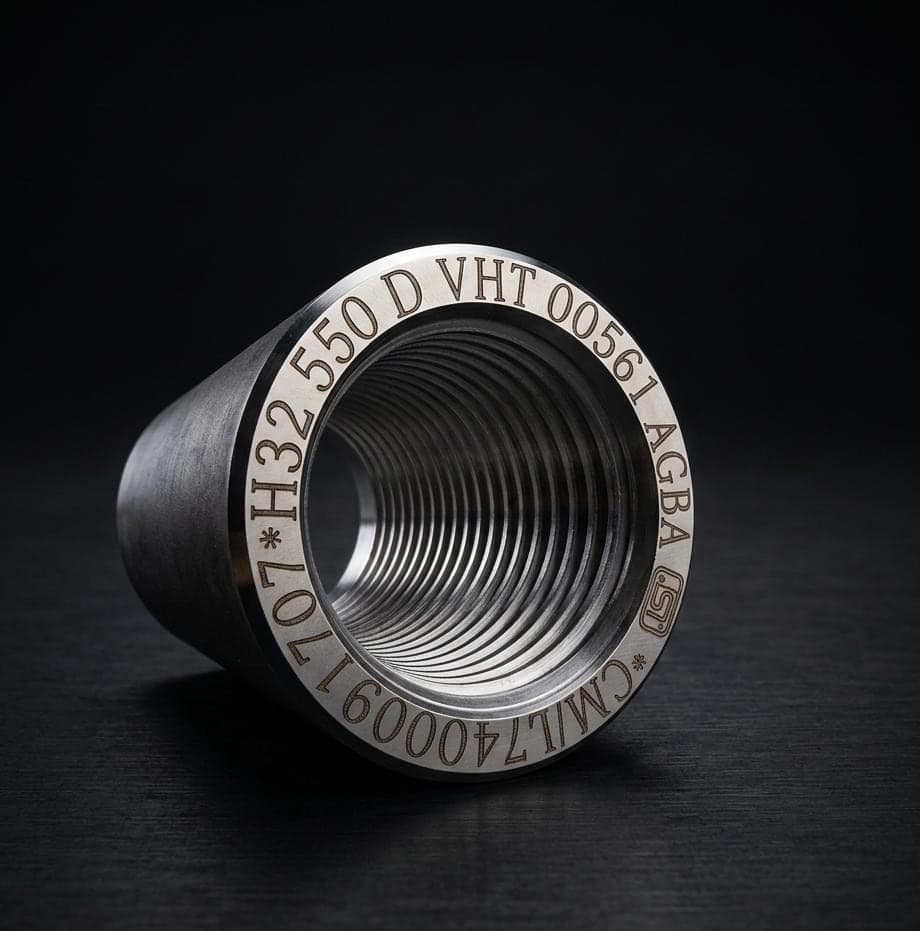
Every AGBA coupler is manufactured and independently tested to national and international standards, with a NABL test certificate shipped on every single batch. The proof travels with your order.
IS 16172:2023
Couplers for mechanical splicing of bars — Class L & H, the governing Indian standard.
ISO 9001:2015
Certified quality management system across manufacturing and dispatch.
ISO 45001:2018
Occupational health & safety management certification at our works.
NABL Tested
Independent lab testing with a signed test certificate on every batch.
A rebar coupler is a threaded steel sleeve that joins two reinforcement bars end to end, so the join carries load as though the bar were continuous. It replaces the lap splice — the older method of simply overlapping two bars and trusting the concrete between them. The bar ends are cold-forged, cut to a parallel thread form and drawn into the sleeve until the two faces meet, so the load path runs bar, thread, coupler, thread, bar — in steel the whole way, with nothing asked of the concrete around it. IS 16172:2023 governs what that connection has to achieve on thread engagement, tensile strength and behaviour under repeated load, and grades couplers Class L or Class H against it.
The load passes through steel threads in contact, not through the concrete surrounding an overlap. The splice behaves like the parent bar.
A lap splice needs an overlap of 40 to 60 times the bar diameter. A mechanical splice is a fixed short length, regardless of concrete grade or cover.
Every lap buries a length of bar in the overlap and pays for it twice, at both ends of every join. A coupler takes that length out of the order, which on a tall frame is measured in tonnes rather than metres.
No doubled-up bars at column-beam junctions — exactly where congestion, honeycombing and vibrator access are already worst.
Staged pours, precast connections, congested column heads, and bars that have to be spliced at one plane — cases where the code limits how much may be lapped at a section, or where there is simply no room to lap at all.
Every coupler is gauged, every batch is tested, and the certificate ties back to the heat number of the steel it was made from.
Lap splice against mechanical splice, drawn at the same scale on the same bar.
A splice depends on two halves — a cold-forged bar end and a precision-engineered coupler. In a high-rise column, both carry the load. Cut threads straight into the bar and you sever the grain at every root, reducing the load-bearing section. AGBA upsets the bar end first, so the net section is preserved and grain flows through the threads.
Threads cut into the bar. Cross-section reduced, grain severed — the coupler thread strips under load.
The bar end is cold-upset before threading. The original section is retained and grain flows around the thread form, so the splice fails in the parent bar, not the join.
AGBA couplers meet IS 16172 on thread engagement, tensile and fatigue performance — then go further. A 7.75 mm wall on a 32 mm bar versus a conventional 10–12 mm means engineered clearance, built to pour.
7.75 mm
OD 53 mm · free concrete flow
10–12 mm
OD 58–62 mm · high pour risk
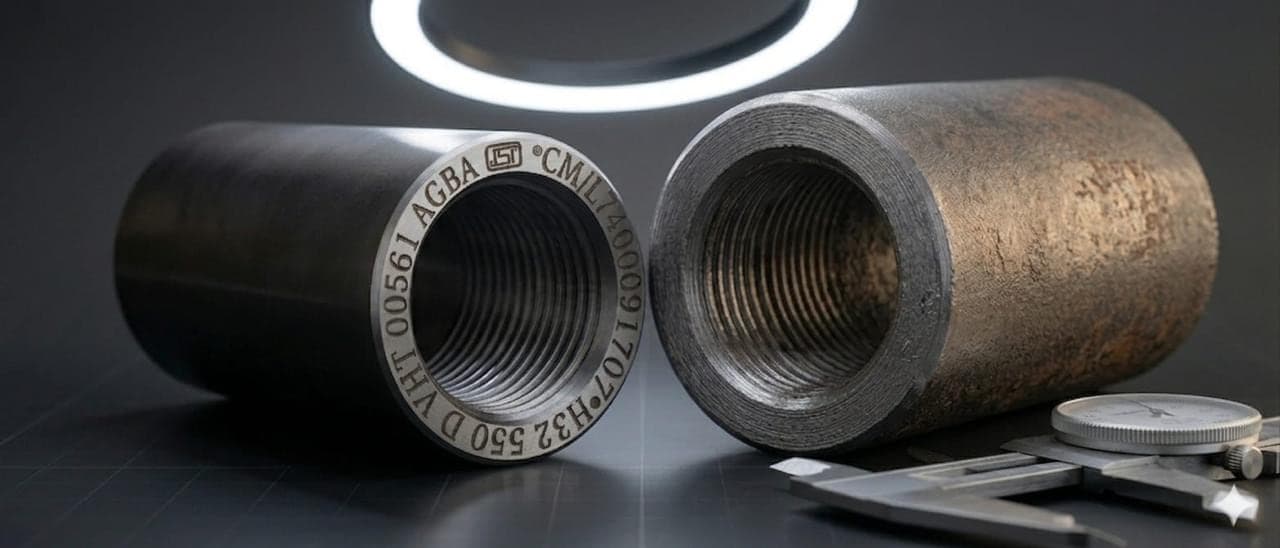
From the certified coupler to on-site forging, lab certification and pan-India dispatch — one accountable source for the whole connection.
The core product — IS 16172:2023 Class L & H certified for Fe 500D/550D rebar across Ø12–40 mm.
On-site bar-end upset forging and threading with gauge-verified output on every bar.
Engineered couplers across all standard industry sizes — each one checked and verified.
A NABL-accredited independent test certificate ships with every single batch.
Direct-to-site logistics from Butibori MIDC, Nagpur, with full technical support.
Every coupler plug-gauged. Failures are scrapped — never reworked. No sampling.
Six controlled stages from steel intake to dispatch — with quality verification built into each one, not bolted on at the end.
Tested pipe. Heat number logged and carried with the batch to dispatch.
Pipe cut to required sizes and dimensionally verified.
Parallel thread to IS 16172 Annex G. Pitch, form & depth gauge-verified.
Every coupler gauged. Fails are scrapped, not reworked. No sampling.
Every batch tested at a NABL-approved lab; certificate ships with the consignment.
Lot code, class and grade marked. Direct-to-site across India.
Whether you're a contractor, consultant or distributor, our team is ready with sizing, certificates and pricing.